
NUCLEAR ENGINEERING & SCIENTIFIC COMPUTING
Coupled physics.
High-performance computing.
Neutronics–thermal-hydraulics coupling, parallel scientific software and numerical methods for reactor analysis.
Discuss your calculation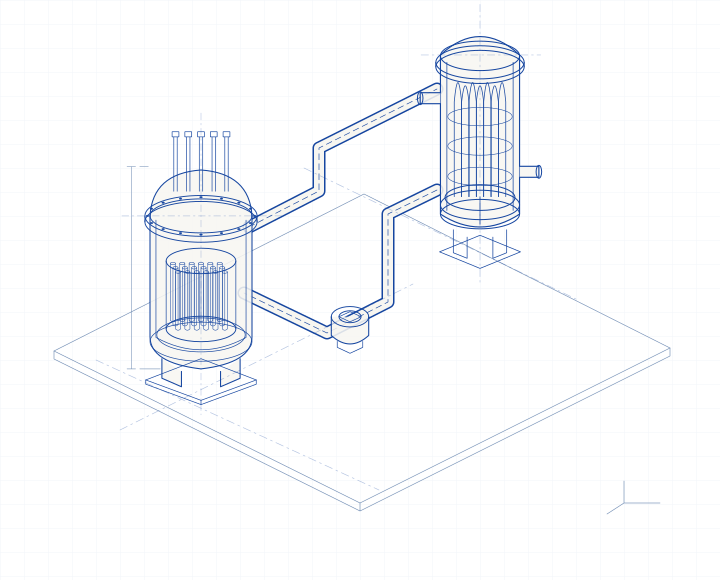
EXPERTISE
From component models
to coupled calculations.
Specialist work on the numerical methods and software that connect reactor physics, heat transfer and fluid flow.
Reactor core
Neutronics–thermal-hydraulics coupling
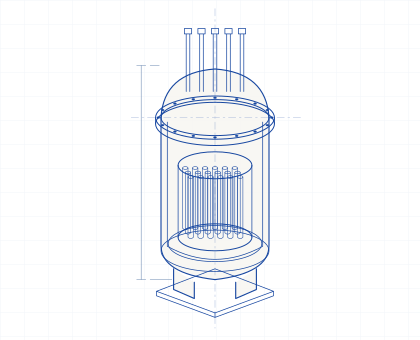
Couple fission power, fuel temperature and coolant feedback. Assess convergence, time-step sensitivity and the cost of the coupled solve.
Primary circuit
Multiscale thermal hydraulics
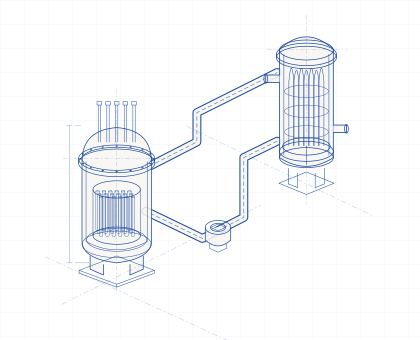
Connect component-scale flow calculations with system models. Define exchanged fields, boundary conditions and conservation checks.
Heat exchanger
Thermal interfaces & code integration
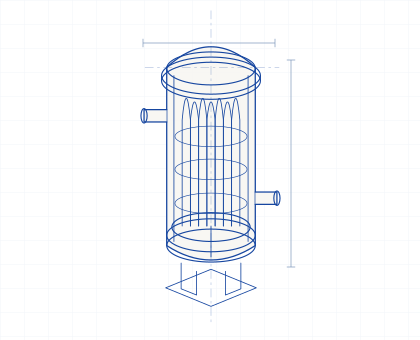
Transfer heat and flow information between models. Build interfaces that keep units, mappings and solver assumptions explicit.
HIGH-PERFORMANCE COMPUTING
Computational performance,
measured.
Profile the calculation, identify the bottleneck and evaluate the parallel strategy. Measure wall-clock time, memory use and scaling alongside the numerical accuracy required by the problem.
For coupled simulations, compare methods at matched tolerances and count the work inside the physics solvers. Fewer outer iterations alone do not establish a faster calculation.
Typical outputs: a coupling implementation, a reproducible benchmark or a documented performance assessment.

ABOUT
Federico Caccia
Nuclear engineer. Scientific software developer.
I trained as a nuclear engineer at Instituto Balseiro, where I also completed a master’s in engineering. At Argentina’s National Atomic Energy Commission (CNEA), I worked on simulation and safety analysis for the RA-10 research reactor.
My research includes multiscale fluid dynamics and implicit neutronics–thermal-hydraulics coupling. I later co-founded Rather Labs and led software engineering teams. Through Astra Nuclear, I bring that background to focused work on coupled models and high-performance scientific computing.
RESEARCH & WRITING
Selected work.
Publications and technical notes by Federico Caccia, including work with research collaborators.
- Read the article
Neutronics–Thermal-Hydraulics Coupling: An SMR Example
A reduced-model comparison of lagged exchange, Picard iteration and Newton methods.
- View the abstract
Implicit methods for neutronics–thermal-hydraulics coupling
F. A. Caccia & E. A. Dari · ENIEF 2017. Original title: Métodos implícitos en acoplamiento neutrónico-termohidráulico.
- View on ResearchGate
Multiscale Coupling in Fluid Dynamics Calculations
Federico Caccia · coupling models at different scales for fluid-dynamics calculations.
- View on ResearchGate
Three-dimensional hydrodynamic modeling of the second shutdown system of an experimental nuclear reactor
L. M. Rechiman, M. I. Cantero, F. A. Caccia, A. Chacoma & E. A. Dari · Nuclear Engineering and Design 319 (2017), 163–175.
Three-dimensional CFD modelling of the RA-10 second shutdown system, coupled to the draining pipe network and assessed against mockup experiments.